Advancing efficient and sustainable seaweed production through the SALINA project.
Kerteminde Seafarm has recently completed its autumn deployment of sugar kelp (Saccharina Latissima) in Kerteminde Bay, Denmark. As part of the European SALINA project, this cultivation season focuses on two seeding methods: twine seeding and direct seeding. Both offer distinct advantages and challenges in terms of biomass yield, production costs, operational efficiency, scalability and sustainability.
Direct seeding – a pathway towards industrial-scale cultivation
Direct seeding involves applying juvenile sporophytes directly onto grow-out ropes using a biological adhesive and an automated seeding machine, enabling seeding speeds of up to 1,000 metres per hour. The method offers the potential for repeated harvests from the same ropes for up to four years without annual reseeding.
Advantages: Fast, cost-effective and scalable seeding; reduced labour requirements; rapid deployment; stable mechanical performance of grow-out ropes; and improved sustainability through multi-year rope reuse and reduced material consumption.
Challenges: Generally lower first-year biomass yields compared with twine seeding, and a risk of unsuccessful seeding resulting in limited or no growth. Successful initial attachment and favourable environmental conditions are critical.
Twine seeding – reliable growth and high first-year yields
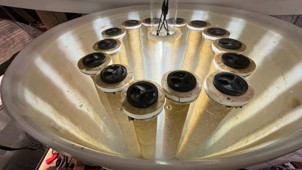
Spores are released directly into seawater containing spools of thin twine. The spores settle and attach to the twine, develop into gametophytes and, following fertilisation, form juvenile sporophytes under controlled laboratory conditions. The seeded twine is then wound around the supporting grow-out rope before deployment at sea.
Advantages: High first-year biomass yields, reliable establishment and predictable growth, supported by greater biological control during the hatchery phase.
Challenges: Limited scalability, higher production costs, slower and more labour-intensive deployment, and a risk of mechanical instability between the seeded twine and the supporting rope.
Developing the H-RIG horizontal cultivation system
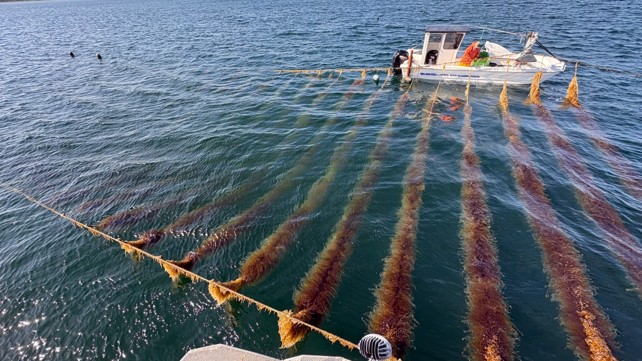
Alongside seeding innovation, Kerteminde Seafarm is developing its H-RIG system, with horizontal grow-out ropes spanning two parallel mainlines. The modular design aims to increase cultivation capacity, simplify deployment and harvesting, and improve operational efficiency in exposed waters. Combining H-RIG with automated direct seeding and multi-year rope reuse offers a promising pathway towards industrial-scale cultivation.
Towards more sustainable and competitive seaweed production
Through SALINA, Kerteminde Seafarm aims to evaluate the biological, technical, economic and environmental performance of both seeding methods. While twine seeding offers greater production reliability and higher initial biomass yields, direct seeding has considerable potential to improve long-term profitability, operational efficiency and sustainability through automation and multi-year cultivation.
The comparison will extend beyond first-year biomass yields, considering accumulated biomass production, production costs per kilogram, material consumption and operational requirements over multiple cultivation seasons.
Understanding these trade-offs is essential for commercially viable seaweed cultivation and scaling up Integrated Multi-Trophic Aquaculture (IMTA) in European waters, supporting a competitive and regenerative blue bioeconomy.